If you’ve been in London at all this summer it can’t have escaped your notice that there is a big anniversary this year, being celebrated throughout the capital. On 2nd September 2016 we commemorated 350 years since that famous fire caught flame on Pudding Lane and ravaged the medieval City for four long days. The anniversary day culminated in a magnificent spectacle on the river Thames whereby a wooden replica of the 17th century city was set aflame to awestruck crowds. You can watch it here if you missed it.
But it doesn’t end there. Amongst a varied, city-wide, events programme the Museum of London’s major exhibition: Fire! Fire! is showing until February 2017 and I highly recommend a visit.
The exhibition is ambitious and theatrically staged – with the mood and atmosphere of each room emulating the lifespan of the fire itself. You enter a darkened corridor evoking a dimly lit 17th century street, complete with authentic street lamps and beautifully carved wooden brackets.


Gentle murmurs and walking shadows add to the dingy ambience and sense of looming anxiety as you are led towards the scene of Thomas Farriner’s bakery, where it all began. An animation plays on the wall and you are encouraged to watch the slumbering shadows stir as smoke slowly drifts toward their nostrils forcing them firstly out of their bed and then, hesitantly, through the window to the street below.
The scene having been set, you find yourself in a small room wrapped in a timeline of the events, complete with a table map in the centre above which float several giant loafs of bread (I suppose in case you had missed the bit about where it was started). Onwards into the main exhibition space, you are guided by a glimmering light and the subtle spit of crackling flames. Here the focus is on the objects, buildings and people whose lives were charred. Despite the emphasis being very much on a child-friendly explanation of everything – with an often frustratingly shallow depth of information imparted on the panels – there are some glimpses into the lives of those who were affected.
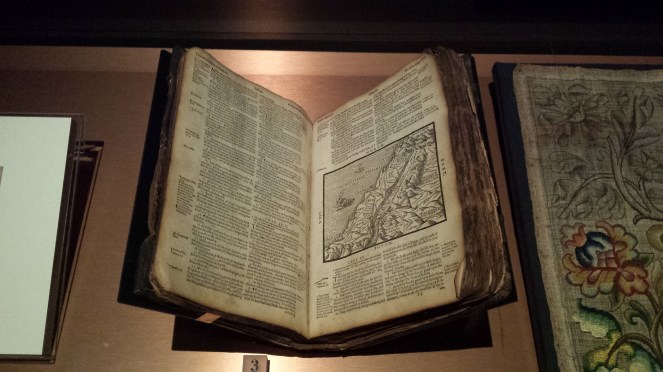
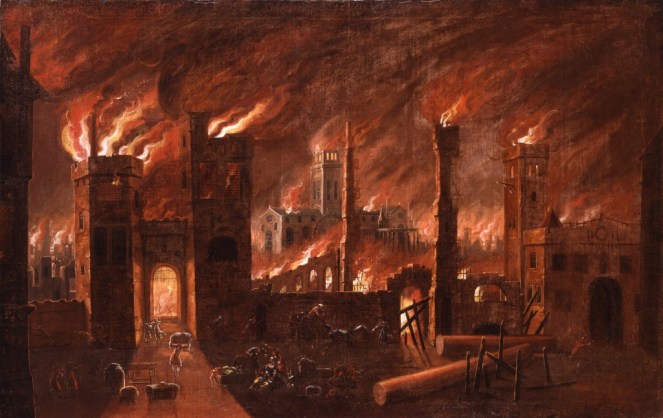
Most poignant to me was a bible, so ridden with burns that you could almost smell the smoke (if it were not for the glass display case) and several fantastically evocative and glowing paintings, depicting the blaze in a way that words simply could not. Some of the snippets added into their descriptions are thought-provoking and encourage you to consider the lesser talked about consequences of the fire. Just how many people it affected and how much carnage there must have been are strong themes that I took away with me – in a way that, regrettably, I may have previously missed, having been stunned by the spectacle of such a landmark event rather than the stark reality. A 1675 painting by Jan Griffier the Elder depicts a scene in which Newgate prisoners are moved to safety in Southwark with many making their escape en route; perhaps some of the few people who’s lives the fire improved rather than extinguished.
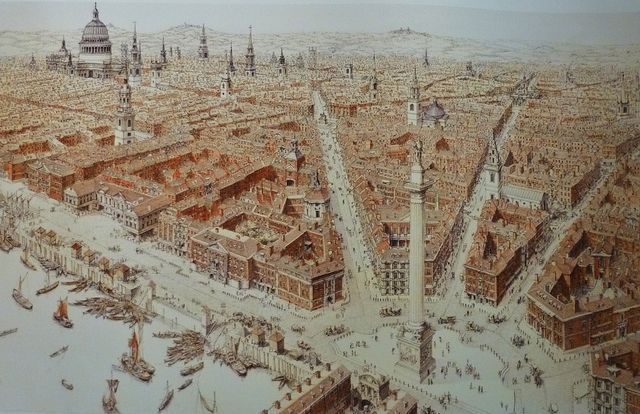
The final two exhibition rooms move the narrative journey to the aftermath of fire and the rebuilding of the City. The mood is clearer, lighter and in some ways starker. We learn about the hoards of newly displaced people, setting up camp in the vast green outskirts of the capital and campaigning for their right to a home, in a tale that sounds sadly familiar to a modern audience, accustomed to stories from the Calais jungle and beyond. Objects on display here include scorched tiles and other blackened remnants, a commemorative stone from a long forgotten church and wooden shop signs illustrative of a new London. Proposals and maps depict ambitious and unrealised plans about the London that never was. You leave with a sense of a city almost completely renewed but with a strong echo of its past. A contemporary print by Paul Draper shows us what may have been if Wren had been given free reign – though personally, I am grateful for the stubborn land and property-owners, without whom I may never have wandered the City’s winding and atmospheric alleyways.
 Georgian vice
2 thoughts on “Exhibition Review: Fire! Fire!”