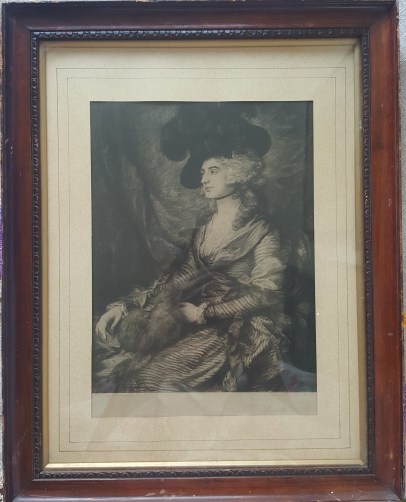
That hat, with its opulent, cascading plumes, like a fountain in St James Park! Those silken swathes of fabric, richly draped across her shoulders. And that slightly glum expression she holds, borne of someone with a story to tell. ‘I know that woman!’ Finally, the glimmer of recognition that is so rare when rifling through paintings at a boot fair. I knew who this was and I knew some of her story. I knew she was relevant. And the frame! The beautiful smooth mahogany, smattered with the patina of its years. It must have hung on so many walls, inspiring so many to explore her tale.
‘She’ is, or was, Sarah Siddons. A name – in the first age of celebrity – that would have produced a large ‘ohhhh’ of recognition but is now almost lost in obscurity, just faintly whispering on via an award given annually for ‘outstanding excellence in Chicago theatre’.
Known as the tragedienne of the eighteenth century stage, at her height Mrs Siddons could fill an auditorium faster than Michael Bublé on a Saga Holidays cruise. From transfixing audiences with her confident and, at that time, uniquely human portrayal of Lady Macbeth, to being appointed to read to royalty, Siddons rose from humble Brecon beginnings to being the luminary of London. Her stage success led to several renowned portraitists depicting her form. This print, so readily discarded into the boot fair bargain bucket, was taken from Thomas Gainsborough’s richly coloured 1785 masterpiece and would have been copied for prints such as this many times over. Displayed in the windows of print shops in the Capital and beyond, their subjects became instantly celebrated and recognisable. In an age when it had only recently become acceptable for women to be respected for acting, Siddons topped the bill.
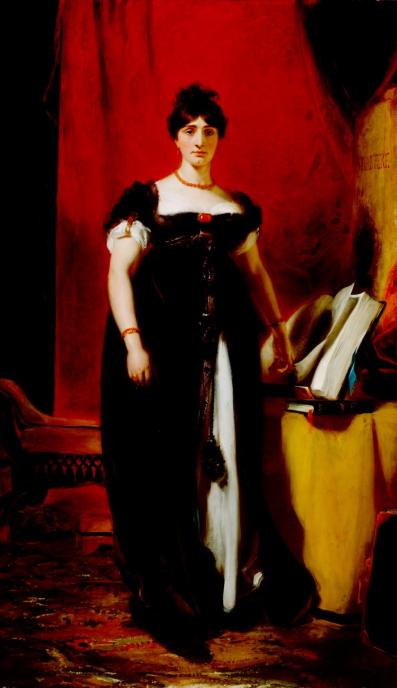
There was sadness in her, on- and off-stage. You can see it in her eyes I think, both in my print and in a later portrayal of her by Thomas Lawrence, now hanging in the Tate Britain – where I spotted it with that same delight of recognition just last week. Here, in 1812, her fame has faded and she has been discarded from the beau monde, just as her print portrait would be 200 years later. By this point, tragedy had followed her backstage and she had been plagued by a deeply unhappy marriage and the heart-breaking loss of five of her seven children. The ‘Siddons’ in her name belonged to her husband William, a fellow but far less successful actor, and so did her earnings. As was the way back then, a woman could not own a thing, not even herself, and all possessions became the property of her husband. Sadly for Sarah, William was as bad at accounting as he was at acting, something which led to her obsessively working for fear of the future financial troubles they would face. Perhaps history has been unkind to William but he comes off as something of a ‘bad egg’, because money wasn’t the only thing he was spending freely. In 1792 Sarah made the unfortunate discovery that an episode of ill health was the consequence of venereal disease… she’d got the clap just as the claps were dying down.
As the nineteenth century drew on, Sarah gradually retired from the stage, agreeing only to the odd recital or reading before stopping completely. She died aged 75, in 1831. In death she once more received the praise of her earlier years – with an estimated 5,000 mourners crowded around St Mary’s churchyard in Paddington.
 Georgian vice