© Victoria and Albert Museum, London
Part One: Take care of your lungs.
I recently visited Cyprus for a short holiday to get away from it all and immerse myself in a different culture. It was probably the first time I have travelled abroad without purchasing a guidebook beforehand. Maybe that’s a sign of the times.. with free wifi in the holiday apartment I could easily do all of the research I needed by using my phone when there. For eighteenth century holidaymakers even a short trip across the channel was a visit into the exotic unknown and guidebooks written by their fellow patriates offered comfort and familiar companionship for the unseasoned traveller.
I am grateful for them too, as they provide a glimpse of the parts of past life deemed too mundane for Englishmen to have mentioned. In a small selection I have recently been exploring in the British Library, our foreign friends have passed comment on our strange customs and marvelled at the innovations of our great city. They described the streets, the air, the buildings and parks, the national character, the men, the women… in fact, they covered such a huge range of topics that I have decided to run a short thematic series on this blog.
In this first part, the focus is on a theme that crops up again and again when looking at historical London: the smog. We often think of the smog in relation to the Victorian industrialists but, as these travel guides show, the London air was long infused by the time they came along.
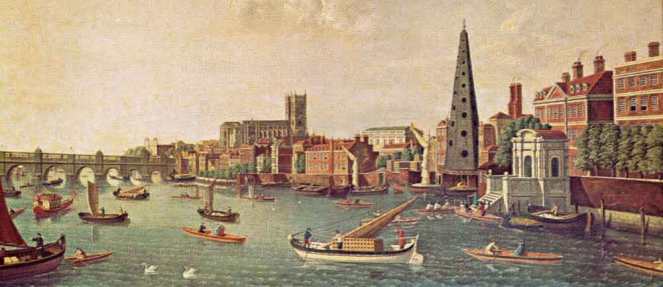
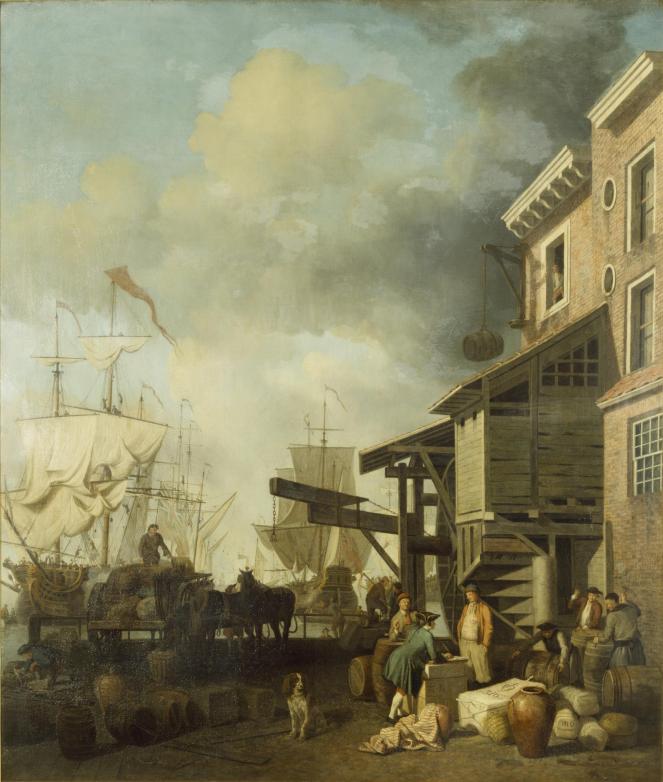
Having survived the salty, swirling, sick-making sail across the channel and the cluttering carriage ride through the Kentish countryside, many of these visitors arrived at the London docks in awe of the vast and murky metropolis before them. Even the land-travelled Scot, William Mavor, described his astonishment upon his first glimpse in 1782:
“We first described London enveloped in a thick smoke, or fog. St. Paul’s arose, like some huge mountain, above the enormous mass of small buildings. The monument, a very lofty column erected in memory of the great fire of London, exhibited to us, perhaps, chiefly on account of its immediate height, apparently so disproportioned to its other dimension, an unusual singular appearance. Westminster Abbey, the Tower, a steeple, one church and then another, opened successfully to our view; and we could now plainly distinguish the high, round chimneys, on the tops of the houses, which yet seemed to us to form an innumerable number of smaller spires, or steeples.” (Mavor, Wiliam ‘The British Tourists; or Traveller’s pocket companion, through England, Wales, Scotland and Ireland. Comprehending the most celebrated tours in the British Islands’)
And he wasn’t the only one whose vision was clouded, following his visit in 1765, the Frenchman Pierre-Jean Grosley remarked:
“The smoke gains ground every day: if the increase of London proceeds as far as it may, the inhabitants must at last bid adieu to all hopes of ever seeing the sun. This smoke, being loaded with terrestrial particles, and rolling in a thick, heavy atmosphere, forms a cloud, which envelopes London like a mantle; a cloud which the sun pervades but rarely; a cloud which, recoiling back upon itself, suffers the sun to break out only now and then, which casual appearance procures the Londoners a few of what they call glorious days.”
Grosley is so taken aback by this smoke-filled atmosphere that he continues to two whole pages of his journal with further description. Here he perplexes over the dreadful effect the smoke has on his clothes via the blackening of the rain:
“The vapours, fogs and rains, with which the atmosphere of London is loaded, drag with them in their fall the heaviest particles of the smoke; this forms black rains, and produces all the ill effects that may justly be expected from it upon the cloaths of those who are exposed to it. Their effect is the more certain and unavoidable, as it is a rule with the people of London, not to use, or suffer foreigners to use, our umbrellas of taffeta or waxed silk: for this reason, London swarms with shops of scourers busied in scouring, repairing and new furbishing, the cloaths that are smoked in this manner. This scouring is perpetual.”
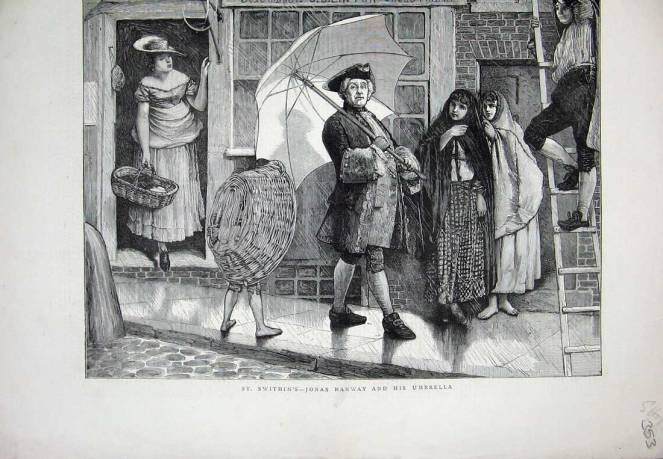 Jonas Hanway and his umbrella, source unknown.
According to legend, we British were slow to take to the concept of using an umbrella to see off the rain, and astonishingly were relucatant to do so until the Marine Society and Foundling Hospital philanthropist, Jonas Hanway (1712- 1786), bravely and persistently led the way despite being continuously threatened and abused by Hackney carriage drivers who thought the practice would diminish their trade (you could say that umbrellas were the Uber of their day!)
 Georgian vice
It’s so strange to think that London has suffered with smog for such a long time! My dad was explaining how he’d wander about as a child in London and not even be able to see the other side of the road! Even now, I notice how much clearer the skies are the further out of London I go…crazy!
LikeLike